

Performance Management Calibration: How to Do It Right in 2026
Discover how performance management calibration works in 2026, with unified data, structured decisions, and outcomes that hold up in practice.
Performance management calibration is supposed to make employee ratings more consistent and fair. In theory, it helps managers apply the same standards across teams instead of relying on personal judgment alone.
In practice, many calibration sessions still fall short. Teams spend hours debating ratings, but the same problems keep showing up: unclear standards, uneven manager input, missing compensation context, and decisions that do not hold up once the cycle moves into execution.
That is why calibration still fails in 2026. The issue is usually not a lack of effort from HR. It is that the process often runs without the data, budget context, and system controls needed to support better decisions.
This article explains what performance management calibration is, where it breaks down, and what a functional calibration process should look like today.
Key Takeaways
- Calibration often breaks down when performance, compensation, and budget data are not available in a single, shared view during the session.
- Employees in less visible roles, such as remote or cross-functional positions, can be evaluated less consistently when discussions rely on recall instead of structured data.
- Calibration decisions only matter if they carry through to execution. Without system enforcement and clear documentation, outcomes can change after the session.
- AI is beginning to shift calibration from a retrospective exercise to a more real-time, data-supported process, but only when the underlying data is reliable.
- Platforms like CandorIQ help bring performance and compensation data together, so calibration discussions start with context and lead to decisions that hold up in practice.

What Is Performance Management Calibration?
Performance management calibration is meant to make employee ratings more consistent across teams. Instead of each manager applying their own standards, ratings are reviewed collectively, so similar performance is evaluated the same way.
The goal is straightforward. Reduce rating inflation and limit bias across the organization
But this is where things often get blurred. Calibration is frequently confused with a narrower process that happens at the end of the review cycle.
Performance Management Calibration vs. Performance Review Calibration
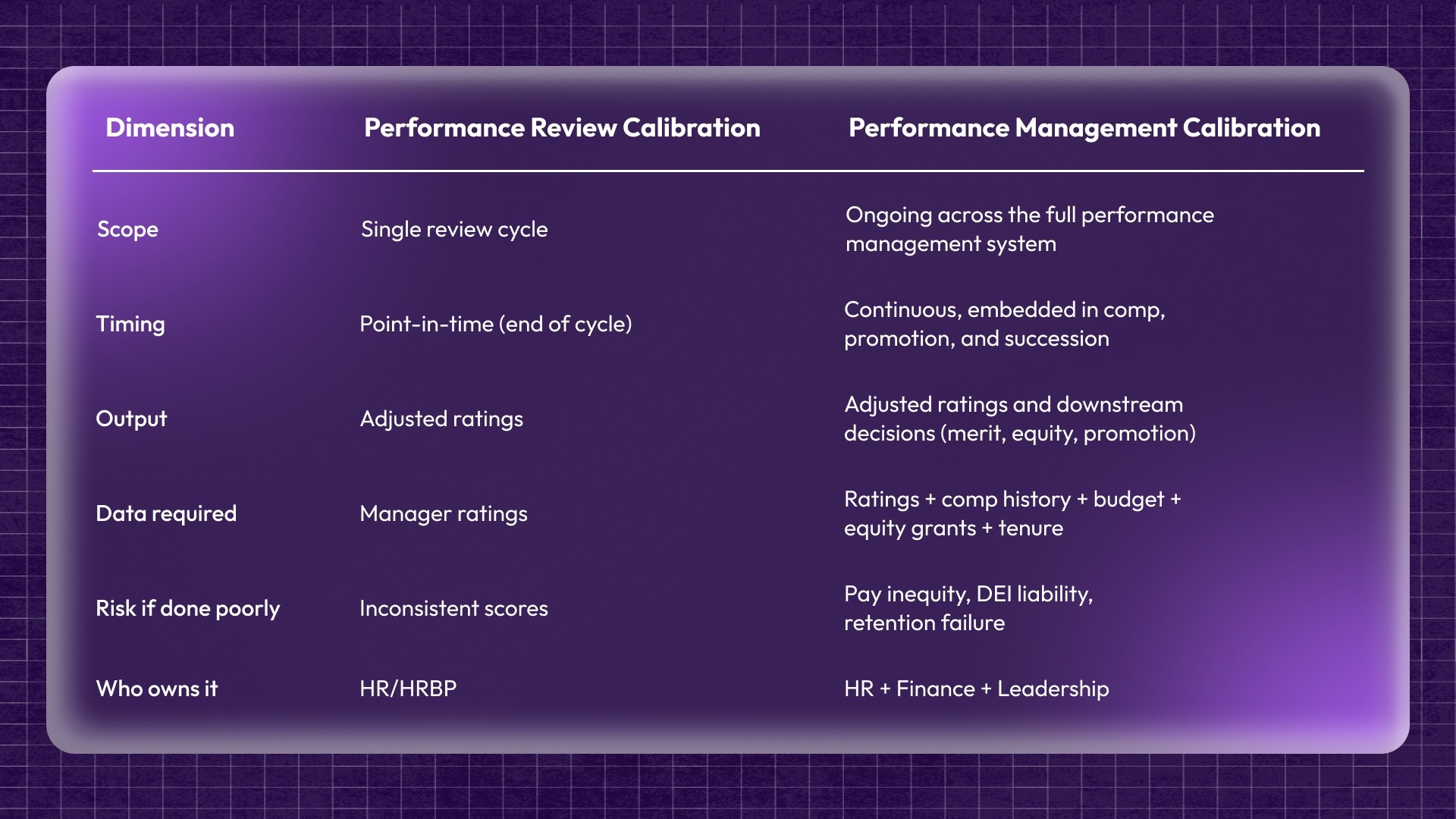
These terms are often used interchangeably, but they operate at different levels. Treating them as the same thing is one reason many calibration efforts fall short.
Review calibration is a checkpoint. Performance management calibration is the system behind it. When organizations treat them as the same thing, they end up improving the discussion, but not the decisions.
So what was performance management calibration actually designed to fix?
What Performance Management Calibration Was Built to Solve?
Calibration did not emerge as a best practice. It came out of repeated problems in how performance was evaluated across teams, problems that became more visible as organizations grew.
A few patterns showed up consistently. For example:
- Managers rated in isolation, so most teams ended up looking above average. That made ratings less useful for real differentiation.
- Standards also drifted. The same rating could mean very different things depending on the team. In one function, exceeding expectations might reflect exceptional impact. In another, it might simply mean the employee did their job well.
- Bias further complicated things. Recent work often carried more weight than earlier contributions, and a single high-profile success or failure could shape the entire rating.
- Outcomes were also influenced by how strongly managers advocated. Two employees with similar performance could walk away with different ratings based on how their cases were presented.
- Over time, these inconsistencies did not stay contained within performance reviews. They showed up in compensation. Without a clear link between performance and pay decisions, similar performers started to drift onto different pay paths.
These are not edge cases. They are structural issues that calibration is meant to address.
However, diagnosing the failure is only useful if it points toward a fix. Here's what functional calibration infrastructure actually looks like when those five failure modes are designed out of the process.
How a Functional Performance Management Calibration is Actually Done in 2026

A functional calibration process in 2026 is less about the meeting itself and more about how decisions are supported before, during, and after it.
When it works, it creates consistency across teams without turning the session into a debate driven by opinion.
Here’s how that typically plays out in practice:
Step 1: Start with Data Readiness, Not the Meeting
Most calibration issues begin before the session even starts. If the underlying data is incomplete or fragmented, the discussion quickly turns subjective.
At a minimum, teams need a shared view of:
- Performance ratings alongside current compensation
- Confirmed merit budgets by team or function
- Employee context, such as tenure, past increases, and promotion history
When this information is scattered across systems or pulled in manually, calibration tends to rely more on memory than evidence.
A simple way to pressure-test readiness is if managers walk into the session still asking what’s my budget? or where does this person sit comp-wise?, the process is already off track.
Step 2: Align on Standards Before Comparing People
Calibration is not just about comparing employees. It is about aligning on what different performance levels actually mean.
Without that alignment, discussions drift into interpretation:
- One manager’s exceeds expectations becomes another’s meets expectations
- Ratings reflect individual judgment instead of shared criteria
Strong calibration sessions spend time upfront clarifying:
- What distinguishes each rating level
- What level of impact is expected at different roles or levels
This reduces the need to fix ratings manually later in the discussion.
Step 3: Review Ratings in a Shared, Visible Context
Once standards are aligned, ratings are reviewed across managers—not in isolation.
At this stage, visibility matters:
- Distribution of ratings by manager
- Outliers across teams
- Clusters of high or low ratings
This helps surface patterns early, before the conversation turns into individual advocacy.
Instead of asking, " Why does this person deserve a higher rating?, the discussion shifts to:
- Why does this team look different from others?
- Are we applying the same bar?
Step 4: Keep the Discussion Anchored in Evidence
One of the most common failure points is when calibration turns into a lobbying exercise.
Managers advocate. Others counter. The loudest voice often wins.
Effective sessions avoid this by continuously returning to shared reference points:
- Documented performance outcomes
- Role expectations
- Compensation positioning where relevant
In many organizations, this is where HR (or a designated facilitator) plays a more active role, not as a neutral observer, but as someone who redirects the conversation back to evidence when it drifts.
Step 5: Connect Ratings to Real Decisions
Calibration does not end with adjusted ratings. It only works if those ratings carry through to actual decisions.
That includes:
- Merit increases
- Promotions
- Equity or bonus allocations
When these decisions are made separately, or revisited later without context, the value of calibration starts to erode.
Step 6: Close the Loop and Make Decisions Traceable
The final step is often the weakest. It ensures that decisions are recorded and consistently applied.
In a functional process:
- Calibrated ratings flow directly into compensation planning
- Any overrides are documented with clear reasoning
- Changes are tracked over time
This creates a system you can explain and defend, whether internally (to employees) or externally (for compliance or audits).
Also Read: Understanding the Compa Ratio Performance Matrix for Fair Compensation
But most calibration processes were designed for a different operating environment, when teams were co-located, HR was more centralized, and organizational structures were simpler. In 2026, those assumptions rarely hold. That is where the process starts to break down.
5 Reasons Why Performance Management Calibration Keeps Falling Short

Many calibration challenges are not one-off issues. They tend to repeat across cycles, even when teams try to improve the process.
Here are some of the most common patterns.
1. Data Is Fragmented, So Discussions Turn Subjective
In many organizations, performance, compensation, and budget data do not sit in one place. Managers often walk into calibration without a complete view of the information they need.
As a result, discussions rely more on memory than on evidence. Some managers are able to present stronger narratives, while others are less vocal, even when their team’s performance is comparable.
Over time, this creates gaps in how employees are evaluated. It becomes harder to compare performance fairly when the underlying data is not easily visible or shared.
2. Budgets Are Introduced Too Late in the Process
In some cases, calibration happens before compensation budgets are fully confirmed. Managers discuss ratings and, in many cases, form expectations around outcomes.
When budget constraints are introduced later, those expectations need to be adjusted. This can make the process feel inconsistent and difficult to explain.
Calibration tends to work better when performance discussions and budget context are aligned from the beginning, rather than handled in separate steps.
3. Visibility Influences Outcomes More Than It Should
Employees who work closely with leadership or within highly visible teams often have an advantage in calibration discussions. Those in remote or cross-functional roles may not be as easily recalled in detail.
This does not necessarily reflect differences in performance. It is often a result of how information is surfaced during the session.
Research in performance evaluation has also shown similar patterns in how different groups are assessed. When discussions rely heavily on recall, outcomes can become uneven, even without deliberate bias.
4. Decisions Do Not Always Carry Through
Even when alignment is reached during calibration, the final outcomes do not always match what was discussed.
This can happen when:
- Ratings are re-entered manually
- Changes are made later without clear documentation
- Or systems do not enforce the calibrated decisions
Over time, this weakens the impact of calibration. The process exists, but its outcomes are not consistently applied.
5. The Conversation Lacks a Clear Anchor
Calibration discussions can easily shift from evidence to opinion, especially when there is no shared reference point guiding the conversation.
HR often facilitates these sessions, but without a strong link to data, it becomes harder to keep discussions consistent across managers.
When that happens, factors like communication style or seniority can influence outcomes more than intended. The result is a process that feels structured, but produces uneven results.
Also Read: Best Employee Management Systems for Performance Tracking
Many of these issues point to the same underlying gap. Calibration is often treated as a meeting, rather than a system supported by the right data and processes.
Improving facilitation helps, but it does not fully address these structural challenges. That's where 2026 looks different from every cycle before it.
How AI is Changing Performance Management Calibration in 2026
AI is starting to change how calibration is run, but not by replacing human judgment. Its role is to make patterns easier to see and decisions easier to support with data.
Surfacing Patterns Before the Session
AI can analyze past ratings, feedback, and performance data to highlight patterns before calibration begins.
For example, it can flag:
- Managers whose ratings are consistently higher or lower than peers
- Teams with unusual rating distributions
- Gaps between performance ratings and compensation
This helps teams walk into calibration with a clearer starting point, instead of discovering these issues during the discussion.
Adding Context During the Session
During calibration, AI can bring together data that would otherwise require multiple systems or manual work.
That includes:
- Where an employee sits within their pay range
- How their compensation compares to peers
- How ratings align with tenure or role expectations
Instead of switching between spreadsheets, teams can access this context in real time, which keeps the discussion focused.
Highlighting Potential Bias Signals
AI can also help surface patterns that may not be immediately visible.
For instance:
- Consistent under-rating of certain groups
- Gaps between similar performers across teams
- Over-reliance on recent performance signals
These are not decisions the system makes, but signals that help guide a more balanced discussion.
Tracking What Happens After the Session
One of the more practical uses of AI is monitoring what happens after calibration.
It can flag situations where:
- High ratings are not followed by corresponding compensation changes
- Promotion timelines do not align with performance outcomes
- Decisions are changed without clear documentation
This helps close the gap between what is discussed and what actually gets implemented.
However, AI-assisted calibration only works if the underlying data is unified. An AI layer on top of five disconnected systems produces faster confusion, not better decisions. For organizations still running calibration on disconnected data and manual handoffs, it accelerates the same broken outcomes. That's the gap CandorIQ is built to close.
How CandorIQ Solves the Calibration Infrastructure Problem

Most calibration failures trace back to the same root cause: the data that should be in the room isn't, and the systems that should enforce decisions don't. HR teams are left managing a process that produces outputs they can't trust and can't defend.
CandorIQ is a comprehensive compensation and headcount planning platform built for exactly this problem. It consolidates performance data, comp history, merit budgets, pay bands, and headcount plans into a unified system, so calibration sessions start with evidence, not memory.
Our key capabilities relevant to calibration:
- Compensation Cycle management with built-in approval logic, real-time budget tracking, and in-platform rationale logging, so every decision has a documented justification.
- Payband Builder with live pay distribution visualization across the workforce, so comp context is visible alongside performance data in the same view.
- An AI Agent that answers natural language questions about comp gaps, rating distribution, and budget impact, removing the manual data archeology that delays every cycle.
- Workforce Management dashboards that are built for HRBPs, Finance, and leadership, so calibration outcomes are visible to the right stakeholders without manual reporting.
- Headcount Scenario Planning that connects calibration decisions to downstream workforce and budget implications before they're locked.
The result is calibration that produces decisions that are defensible, enforceable, and connected to the comp cycle, not outputs that dissolve in execution.
Get in touch with CandorIQ to see what calibration looks like when the data actually shows up.

FAQs
What is the difference between performance calibration and performance review calibration?
Performance review calibration is a point-in-time adjustment of ratings at the end of a review cycle. Performance management calibration is broader. It connects ratings to comp decisions, promotion timelines, and budget allocation across the full performance management system.
Why does calibration fail to remove bias?
Most calibration sessions run on memory and narrative rather than structured data. When comp history, tenure, and equity data aren't visible in the room, the conversation defaults to advocacy, and advocacy rewards proximity and visibility, not output.
What data should be present in a calibration session?
At minimum: confirmed merit budget by department, current comp mapped against performance ratings, rating distribution by manager, tenure and promotion history, and equity grant history. If any of these are missing, the session cannot produce equity-defensible outcomes.
How do you make calibration decisions stick after the session?
Through system enforcement: calibrated ratings should flow directly into merit modeling without manual re-entry, any override should require documented justification, and the full audit trail should be preserved. Sessions without enforcement mechanisms are meetings, not governance.
How do performance calibration tools support talent management?
Performance calibration tools connect rating decisions to the talent decisions that actually matter, such as promotions, succession planning, merit allocation, and retention. They surface high-potential employees who lack a vocal advocate, create an auditable record linking performance to comp and succession, and give HR and Finance a shared data layer for workforce planning. The result: calibrated ratings flow into real decisions instead of sitting inside a completed review form.
Ready to modernize your workforce and compensation strategy?
See how CandorIQ brings workforce planning and compensation together with AI.